After improving parts of our film that had been pointed out in the feedback, plus areas we had noticed ourselves, we have completed our final cut!!!!!
Tuesday, 21 April 2015
Monday, 20 April 2015
Evaluation Question 4
How did you use media technologies in the construction, research & planning and evaluation stages?
In this evaluation question I will be talking about the different technologies (Software, hardware and web resources) that were used throughout the many stages of my A2 media course to achieve my media products. I will also be discussing the advantages and drawbacks of each technology that I used.
Technologies used throughout:
iMac
 |
| The iMac was used in all of the stages |
The iMac was used throughout the whole media course to access literally every piece of software and web resource that I needed to complete our work. I used the iMac throughout the construction stages of my film and ancillary tasks to use the different software that are required to create my film, poster and magazine review. I used the iMac through the research and planning and evaluation stages to access the web resources I needed to find out the information for my blog posts.
The advantages of using the iMac is that I could access certain softwares such as Final Cut Pro X, which is only accessible on iMacs, which would mean using a computer or laptop with windows wouldn't help us to create our films. At the same time iMacs allow us to surf the internet at the same time which is handy when I used Blogger and needed to find information or watch a video at the same time to complete my posts. The iMac also has a much bigger screen which allows the user to see their work easier and in better quality than other screens.
The drawbacks of using the iMacs would be that they are much more liable to freeze or shut down with no liable explanation which could result in lose of work if not frequently saved or updated. A couple of times throughout the making of my poster, the iMac froze which resulted in me losing time which I could have been using; which isn't helpful if there is a strict deadline approaching and it needs to be completed.
Blogger

 |
| Blogger was used in all of the stages mentioned |
Blogger was used instead of the old-fashioned pen and paper because of its many achievements. Being an up-to-date web resource, Blogger enables me to store work easily and efficently while being able to continuously adapt, remove and add on information whenever I want without having to rewrite the whole page of work. It further allows anybody around the world to see my blog, this being important for my production team and teacher, and use it as a tool for themselves - so for my production team to access any important information and for my teacher to access my work. As I said early, I am less likely to lose my work because Blogger is online and it allows my work to be restored should I accidentally do something wrong while on paper I could lose the work easily and then I would have to rewrite it out if a mistake happened or if I misplaced it. Blogger also saves time and makes deadlines less stressful because instead of taking forever writing pages and pages, I can write loads within an hour which is incredibly handy. Furthermore, images, videos and documentaries can then be embedded into the posts to back up the information that I am talking about which you cannot do on paper.
The drawbacks of Blogger would be that it makes plagiarism easy to commit because it makes your work public, which means everybody can see it and can then copy your work - which is made much simpler with a copy + paste button. This can be a bad thing for school coursework, especially in media when there is a lot of group work and coursework - because it is being graded and if people are copying your work it could hinder grades as it hard to see who copied who.
Another drawback would be if Blogger is down, then you cannot gain access to the website which means you are unable to do any work on your blog until Blogger is up and running again; this could take a few minutes to an hour depending which means you are potentially losing precise time. Blogger also has some small faults that occur every now and again where posts begin to mess up or it doesn't save/update which means you could lose a post and all the work on it which has happened to me on a few occasions and it gets rather irritating.
Another drawback would be if Blogger is down, then you cannot gain access to the website which means you are unable to do any work on your blog until Blogger is up and running again; this could take a few minutes to an hour depending which means you are potentially losing precise time. Blogger also has some small faults that occur every now and again where posts begin to mess up or it doesn't save/update which means you could lose a post and all the work on it which has happened to me on a few occasions and it gets rather irritating.
Technologies used in the research & planning stage:
Internet (Web 2.0) Tools:
YouTube
 |
| YouTube was used through all stages mentioned |
YouTube is a great web resource that allowed me to have quick access to many documentaries, training videos and clips from films that are all collected in one place instead of having to trail from many hours of film footage to find that single clip that I need or read loads of books to gain the information. I used this resource within my research & planning stage to give help back up the research I had done for certain post, this mainly being for the short films posts when I had to find 3 short films. I also used it to find out how to use the new DSLR cameras as well as how to use Photoshop when my production and I were creating our film poster and how to use QuarkXpress for our magazine review. I further used YouTube during the construction stage of my film to upload my finished product, rough cut and animatic for the public to see and so that my production team can access it much easier so that we can all embed them to our blogs.
As I said previously an advantage of this resource is how quickly you can find the videos that you need via the search bar at the top. It prevents many wasted hours of searching and normally comes up with many different video selections for you to chose from - you're bound to find the video you want. Furthermore YouTube makes it easier for us to upload our films and footage only once and allowing us the ability to embed them as a piece of evidence on our blog and access them from home, instead of leaving it as a video on the iMac that is unable to be attached to the blog and leaves us with the disadvantage of not being able to access them from home.
The drawbacks of YouTube could be seen as such things like the fact that our work is being put forth publicly which could cause copyright issues should anybody try to take ownership of our work. Another drawback of YouTube would be that although it allows quicker access to film clips and training videos etc. and gives you lots of choice, the sheer amount is bad because half of them aren't what you need which means you are sitting watching videos for a while till you find the one that helps you - which takes up time and effort.
Wikipedia
I used Wikipedia briefly during the research and planning stages to find out information about short films and to later on gain a brief understanding of flat plans, magazines and film posters. The advantages of Wikipedia is that it gives you all the information you need in a quick and easy way however a drawback is that the information may not be completely correct due to it being edited by many people over time which causes it to be not as realistic as text book.
Scribd

I used Scribd within the research & planning and construction stages of my media course as a way of putting documents onto my blog that would otherwise have no way of being put on there. Once the documents were changed into PDFs I was then able to upload them into the web resource and then embed them into my posts which allowed my to add my films treatment, films shooting schedule and many other documents for the ancillary tasks as well with ease.
The drawbacks of using Sribd could be that it isn't exactly the neatest looking embed as it is rather large and bulky in the middle of your posts and sometimes it can be a bit fiddly to keep changing the documents to PDFs for it to work, however aside from this Scribd is a much easier way of getting the documents onto Blogger. Furthermore Scribd allows others to embed that document onto their blogs from your own which is an advantage because it stops you having to email the documents and printing them off so that you have a copy, it's all on your blog.
Technologies used during the construction stage:
Film:
Pre-Production stage
Celtx

Celtx is a piece of software that myself and my production team used to create the script for our film, We decided to use Celtx, which is a specific programme designed to make it easier to write the screenplays, instead of on paper or on a random word document because it does most of the hard work for you because it sets itself to whatever you need it to be as you write the script every time you press enter. This is an advantage because it means you don't have to completely freak out if you cannot remember a scripts layout because Celtx does it for you; all you need to do really is type in the information you need on your screen play.
Of course though, Celtx must be paid for which is a drawback because it can be expensive and if you wanted to work on any school work - media - from home you couldn't do it on this software, you'd have to do it on word first and then take up more time to then put it into Celtx once you've got back to school. This is just me being picky because it doesn't hinder the quality of work you do, but it does slow down how quickly you get things done because you are unable to access it at home to do for homework. This problem could also go out widely and affect those who do want to use Celtx for home purposes because not everybody wants to keep spending loads of money for a programme - it gets to be a burden after a while.
Production of Product stage
Digital DSLR-600D Camera
 |
| ASSony MX 2000D |

Unlike last year for our AS media course, this year we were given the task of training with a new camera; the Digital DSLR-600D Camera which is smaller and much more advanced then the Sony MX 2000D Camera that we used for our AS media film. Like the old camera, the DSLR has its own advantages and drawbacks that we discovered while using this new piece of hardware.
One advantage is most certainly the size - it's small and easier to carry around and fit into smaller gaps without worrying about it falling over or your arms aching from constant carrying or holding while filming, compared to last year where you were limited to how much space you could film in or what camera angles you could get because the camera was so large and bulky that it wouldn't fit into places.
Another advantage would be the more advanced controls on the DSLR camera - the most beneficial being the focusing which has vastly improved since last years Sony MX 200D because now we have been able to do focus pulls and vertigo shots much more easily because now you are able to alter between manual and automatic focusing as well as having much more crisper footage due to better focusing in general.
The DSLR camera also allowed us to play around with 2-3 lens types if we wanted to that gave us scope to focus easy or do various things depending on the lens used, which is different to last years camera which was just a one lens.
However the drawbacks of the focusing is that on the DSLR is that it is very sensitive and the slightest nudge or the wrong setting could cause the overall footage to be unfocused and blurred in certain areas that you don't want to be - this proved a challenge throughout filming because we were unsure if what we were filming was in focus at times.
Another drawback would be most certainly the manual altering of the exposure. Last year we didn't have to worry about setting the ISO or anything but this year on the DSLR camera it required us to set the exposure and if we set the exposure wrong to our location - which was a problem myself and my team hit on many occasions during filming - then you got really bad quality footage meaning it was either over exposed which made it really bright or under exposed which made it really dark and grainy.
Tracking Dolly

Unlike last year, my A2 film depended on the accurate use of a tracking dolly more heavily in the meaning of there were a few important scenes that needed the tracking dolly and nothing else.. One example of when we used this piece of technology would be at the end of our film at the point 4:38 - 4:50, where the camera tracks forwards following our protagonist Richard into the living room, holds for about 1-2 seconds and then quickly tracks backwards out of the room while the door is swung shut as the murder commences.
The use of the tracking dolly allowed us to get that shot smooth and steady as we moved the camera instead of it had being hand held in which it would most likely be very shaky, especially with moving at the speed near the end of the shot. Using the tripod upon the tracking dolly obviously allowed us to stabilise the camera and position it to get the effective shots without getting tired arms.
Furthermore it is much easier to keep the characters within the cameras frame while moving with the tracking dolly and to get perfect straight movements while doing so rather than having the characters arm or head cut out of the shot because you were too busy trying to keep the camera steady etc.
However, like all pieces of technology there is a drawback to the use of a tracking dolly. The tracks that the dolly is placed upon do not go one forever and are actually quite short which prevents you from moving great distances either way, causing you to have to either stop the recording to move the tracks along or get two people to keep running back and forth placing the end track back onto the front just in time for the camera - although we tried and it didn't really work at all well in the small space we had available.
Exterior Location Recording Kit
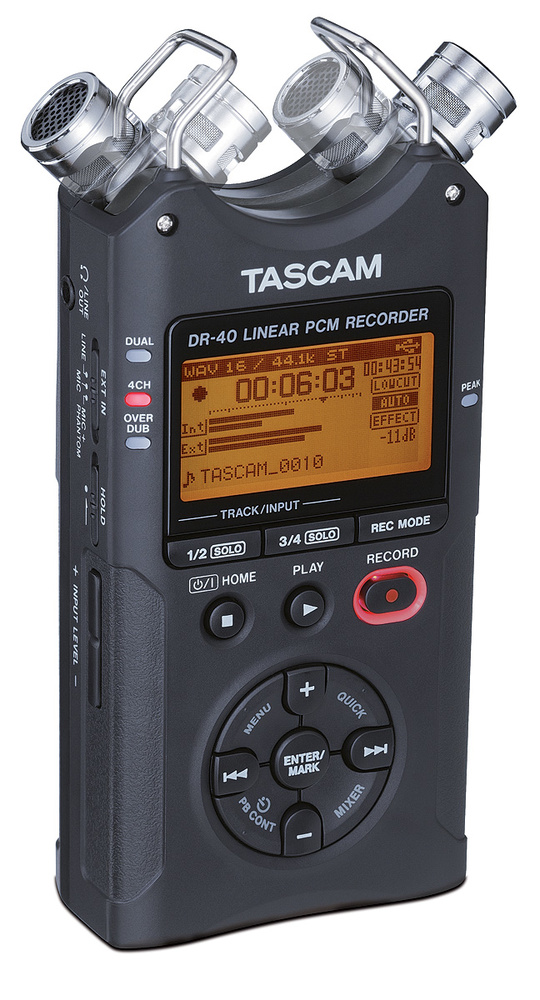
The role of the location recording kit was to record different sounds and dialogue that we wanted to really stand out in our film as it makes the sounds clearer and in better quality than if we hadn't used the recording kit and used the sounds off the normal footage. An example of this would be in our film when our female protagonist Alice runs up the stairs, the sound was too quiet on the camera footage so we had recorded her footsteps with the location recording kit from the same position as the camera was to pick up the noises much better.
The advantages to using this piece of hardware technology would be the fact that it is small and compact, easy to use and very good at picking up every sound that you need efficiently - which means you don't have to use the really quiet sound recording off the camera footage. Being small it means it is easy to hold up and out of sight of the camera and is able to be placed in smaller areas without any worries of it being spotted by the viewers.
The location recording kit is super easy to use and quick to assemble, so it means you are ready to film within seconds - providing the camera etc. is all set up and ready to go. This means its the perfect piece of kit for beginners or to stop time consuming messing around because it only takes a few attachments and you can then use it to record sounds. There is only a few buttons to remember and out of those only a couple or so are vastly important to operate the technology, so its not like a students worst nightmare.
A slight drawback to the location recording kits would be the fact that it does pick up on every single sound which means you could spend a while trying to get the perfect sound recording to go with the footage because different ambience noises keep occurring, like breathing or coughing, and some times cars driving past outside filming locations. Wind is another awful problem when using any sound recording device; it makes a nasty ruck-us down the headphone.
Another is that when you come to import the sounds you recorded onto the iMac (or whatever you are using at the time) its very time consuming and annoying trying to hunt down the many sounds you recorded, this being because the location recording kits are shared items so have many sounds on there. This created a disadvantage because one of my team then had to sit there transferring and listening continuously until he found our sounds - and then he had to hunt through all the bloopers.
Post-Production stage
Final Cut Pro X
Once we had filmed our main product we had to then edit the footage we had to create our desired film, which meant there had to be a change in the technologies we used. Been as throughout the filming stage we had used mainly hardware technologies, now it was time to move onto software technologies - these starting off with Final Cut Pro X. Like the DSLR camera, Final Cut Pro X is a new technology that we have had to train with as it is an updated version of the Final Cut Express we used in our AS course. We used this Final Cut Pro X to put together our footage by cutting it together and adding effects over the film etc. while we also used Final Cut Pro X in replacement of Soundtrack Pro which we used in the AS Course, so we also did our sound editing on Final Cut Pro X.
The advantages of Final Cut Pro X would be that it has everything in one. No longer do we have the difficulty of last year where we had to edit the footage in one programme (Final Cut Express) and then export it to another programme (Soundtrack Pro) to edit the sound and make sure everything sinks perfectly. Now we were able to edit it all together in the same piece of software so the chances of mistakes are considerably lower. This means the quality of our coursework has a better chance of being even better and less stressful.
Another advantage of the Final Cut Pro X is that it has its own title pages and effects that you can add onto your film footage to make it look a certain way - which really helped my production team and I with our film because we found two really good effects that matched our film and helped create what we wanted. With the old final cut pro we weren't able to do this, it was just the basic effects like black and white or sepia, so I feel this is a much better version to be using and is a lot easier once you get to grips with it.
However saying that, a drawback of Final Cut Pro X would be that it is actually a little harder to understand to begin with and you spend a while learning all the tricks about it, however once you get to grips with the software its a breeze to use and create some much better quality films than with Final Cut Express.
FreeSFX.co.uk

The freeSFX & Audio network web resources were websites I had used for my AS product and I felt offered quite a lot of appropriate sounds for the type of film genre that I enjoy creating, as well as offering a wide range of soundtracks that go with many different genre types. Being on the internet, it was right there for me to access and enabled me to select the music I wanted and download it to the iMac for use in my film.
An advantage of this website is that the soundtracks and effects are all free of charge and they do not have any copyright laws attached to them, which means they are free for the taking, unlike many other web resources that offer music such as ITunes. Not everybody wants to pay for a random soundtrack, especially if its only for something simple and that they could potentially only use once; it seems like a waste of money, so this website really saved us from a film with either no music or extremely bad music.
Drawbacks of using these free sounds websites would be that sometimes the quality of the soundtracks aren't as good as the ones you'd buy - which could affect the work that you are trying to put the sounds onto. Furthermore the websites are often down which means you cannot access the sounds you need when you want to - a common problem with web resources.
Audio.lgfl.org.uk

Magazine:
QuarkXpress

QuarkXpress was the software I used to create my magazine review page for my film, which I used on the iMac. Again I'm going to quickly note down the disadvantages and the advantages of this piece of technology down below.
The advantages of QuarkXpress is that it has many powerful design tools that allow the user to get the exact design they want which enables the creation of unique and useful work. Without the powerful design tools, you could find that the tools aren't that good and that you have to do a lot more to get the end result that you wish for,
Another advantage of QuarkXpress is that it is easy to use as its all organized and presented neatly for you to find the tools you are looking for, without having to scavenge through millions of drop-down boxes etc. it's layout is really helpful for those who are just starting out.
Because QuarkXpress is designed to be used in the creation and editing of complex page layouts for such things as flyers or film page reviews it means it is much more efficient to use then a word document or Photoshop and so means less time is wasted because QuarkXpress has all of the tools you need to create the templates.
A drawback of QuarkXpress could also be the layout automation, as well as it being a good thing. It often got annoying while you were trying to place a text box or a shape of some sort down into a certain place and it wouldn't quite go into the area you wanted - this was a problem my team and I encountered briefly in our time of using the software however its easy enough to overcome.
Another drawback, that kinda counteracts a good point, is that QuarkXpress is rather hard to understand and learn quickly. Its a breeze once you know how but it takes a while to fully learn everything about it - which means you could be missing out on something that could put the edge on your work. This makes the software bad for beginners who are seeking something quick and easy to throw together a layout of some sort.
Film Poster:
White Backdrop

The white backdrop was used during the creation of my film poster when my production team and I made arrangements with our former cast members for them to come back so that we could take photos of them ready to be uploaded into a software called Photoshop.
The advantages of the white backdrop is that it makes life so much easier when operating Photoshop because it makes the background of the actor or object you are taking a photo of all one colour so that its easier to remove on the software.
Furthermore it gives a much more professional look to your work as you don't have any distracting objects in the background, only white which gives a crisper edge and makes whatever you capturing on camera stand out.
The drawbacks on the white backdrop is that it was very fragile and any slight fold in the material would show up on camera as a darker grey which wouldn't help in Photoshop and also took off from the professionalism.
Also shadows showed up much worse on the white backdrop so while we were taking the photos we had to make sure our key lights and a cast members were in a good position to stop their own shadows from sprouting up behind them and ruining the photo.
Key Lights x3

I used the key lights during the creation of the ancillary task: film poster. They were used to light up every angle of the white backdrop to erase any shadows that may were upon it as well as create any shadows we may want upon our cast members faces, or to get rid of them if they key lights were placed correctly.
The advantages of key lights would be that because they are so large they completely abolish any unwanted shadows as well as create them if you so desired. They help light up any sets that are too dark while you are filming and provide a nice natural glow - depending on the bulb that's in them and the intensity of the light.
However, the drawbacks of the key lights are a few. One, they are rather heavy to carry around and very cumbersome. This means they get very annoying to set up and if you are carrying them from set to set or moving them around for different lighting effects, you have your work cut out.
And two, the lights get incredibly hot which causes a risk because it could possibly burn you - if your silly enough to go near the bulb - but on the off chance that it topples or you did accidentally touch around the bulb and the metal flaps that are used to angle the light (which get hot as well).
Photoshop CS5.1
Photoshop CS5.1 was the piece of software which basically put together my film poster. It was how we combined together the photos we had taken on the white backdrop with text and in an appropriate style that look professional and attractive to an audience.
The advantages of Photoshop CS5.1. It enables the user to combine photos together and do so in a way that really makes the photos their own creation. It also lets them add their own backgrounds and texts as well as adapt single photos in a way they desire. This means they could create a film poster like my production team and I did from scratch and they could also just adapt a photo they have taken to an look even more professional if they did photography for example.
Photoshop allows for quick editing with its organized tools. Once you know the lay out of Photoshop CS5.1 then your away because they are all set out in an easily accessibly way that's labelled and then allows for quick editing of your images. Furthermore the tools that are provided also allow quick editing that is mostly precise, depending on the user, such as the ability to alter the size of the tool for quickness or for neatness. It's also easy to just automatically whiten teeth on a photo or to get rid of red eye with the click of a button.
One drawback of using Photoshop CS5.1 would be that yes it is easy to use once you get to know your way around it, but it takes a lot of training and studying to get to that point as it has so many different controls and things to do that you'd never know how to use it all without training with it first or playing around. Its not a software that you can easily get to grips with as soon as you start it up. It's very professional and aimed at the professionals so there is a lot to take in, so you can only learn the basics in a brief amount of time.
A drawback for me personally would be the expensive of the software as I wanted to take my media work home and work on it there instead of constantly at school, as it would save time but the expensive of getting the software myself stops that so I stuck with doing it at school - which restricts the time I could have on the creation of the poster.
Another drawback would be that some of the tool on Photoshop CS5.1 are rather clumsy and inefficient, although they are designed to make life easier, and so because of this you then have to fiddle even more with the image to fix the errors the tools did before. For example I felt that the background removal tools are a little clumsy in my experience.
Furthermore the original image when modified is ultimately destroyed - if you keep doing more and more changes and then feel something doesn't work and press undo, it only undoes so much which leaves you with a messed up image that you then have to open up another original, that you have taken care to save separately, which has no changes on at all, causing you to have to start from scratch. A way around this would be to keep saving and reopening the latest save but if you forget this then you do find yourself in a bit of a mess.
Technologies used to communicate with production team:
Email


The Great Wyrley High School email was used mainly if a member of my production team or myself needed to send each other a document that we all required. The advantages of using this technology was that every member of my team had the same email ending which meant you didn't have to hunt down their email address.
Furthermore the email provides an address book which allows the user to type in the name of the person they are looking for and are given their school email. It also allows you to attach files to the emails and send them to each other (obviously) and so is a more efficient way then printing them off and then losing them or making them dog-eared.
A drawback of using the school email, being picky now, could be that sometimes the school website is down and doesn't work for some time. If this happens you rarely can get onto your email due to the link being inaccessible. This causes a problem if you have any deadlines coming up and you need the work you attached to an email.
Also people may not get the information on time because not everybody constantly checks their emails and so if an email was sent Monday, they might not get it till Friday which by then could potentially be too late.
Mobile Phones
My production team and I mainly used mobile phones to get in contact with each other throughout the inter of the A2 media course. We used it in the construction stage to let each other know that we had filming on a particular day, that we were editing on other days, to keep tabs on what was being done of the blogs if we had shared work etc.
The advantages of using the mobile phones are the obvious reasons; it allowed to to easily get in contact without worrying about them taking forever to notice been as now-a-days every body has a phone and everybody carries it around with them, so it makes it quicker and more efficient to get hold of someone.
The drawbacks of the mobile phone is that if the other person hasn't got their phone on them or they are on vibrate, there is like minimal chances of getting hold of them - which this is the same for many things as well; like email (not at the computer, don't get it).
The mobile phones were also a problem because they are a distraction. We had them on our persons so that we could get in touch however there is still that urge to get them out and mess with them when you don't need to, which means it takes off from the time you could be doing something important.
Technologies used in the evaluation stage:
Emaze
Last year for my AS media course, I used a software called Prezi for some of my evaluation questions however this year I'm using a similar software called emaze, which is much better as it offers more ways of creating a presentation in much cooler ways like 3D rooms to go around in presenting your work.
Advantages of emaze are that it looks professional and fun at the same time, as well as it now much easier to create the presentations whereas prezi got rather confusing rather quickly while you were trying to make it zoom through different pages. Emaze allows just as much fun but on a more grounded basis and also presents your work in a nice way. Its so much easier because it is nicely organised and you get a small mini training session when you first sign up which tells you how to do everything straight away, and if you have any questions there is a nice big question mark which allows you to find out further information should you require any.
Drawbacks of emaze would be that it gets a little buggy in my experience of using it. I only created one presentation on it, first time, and many of my photos wouldn't work no matter what I did unless I copied their URL so that took a bit of time to sort out, as well as the music started to bug and wouldn't work which resulted in me removing it initially as I had no time to mess around to sort it out. I also had trouble sizing the shared presentation to my blog post - it was HUGE and I couldn't find a way of making it neater and smaller so I ended up editing its embedding code and altering the width from there.
Movie Maker

Windows Live Movie Maker was a piece of software technology which I used within the evaluation question 1 to do a small voice over video on female representation, This software was the only thing I had available to me at home so I used it, but because its so out dated now, or more so not as good as the newer stuff - there are more drawbacks then advantages.
Advantages of movie maker would be that its quick and easy to use so if your a student trying to whim up a quick video its the best thing for you because its rather straight forward and doesn't require a lot of training - if any at all. This new version allows you to create the project and then instantly upload it to a shared place such as YouTube or Facebook which is an upgrade from the last. This means that if you create the video you have a short cut to uploading instead of publishing it to your computer and then uploading again to YouTube; it cuts out the middle man so to speak.
Drawbacks would be many. The first is that you can't overlap any sound and images, its all aligned in rows and so limits your creativity a lot because you can't then blend any music together should there be a gap that needs sorting or if you had to delete a patch of the sound - you can't mask it through overlapping. Another drawback would be that its poor quality, The sound recording is very noisy and doesn't allow for a nice crisp recording, you can hear my laptops fan on it which doesn't sound very professional, You are limited as to what effects you can add to the video because there is only a handful to pick from and the animations available aren't especially great either. Furthermore movie maker can become rather slow the more media you put into it, which wastes time and effort and can sometimes freeze, resulting in the loss of any unsaved work.

Evaluation Question 3
What have you learned from your audience feedback?
During this A2 media course we all received different pieces of feedback in regards to our pitches at the start of the year, our main films, our film posters and our magazine reviews in order for us to see the positives of our work and if there are any negatives. This then meant we could work upon these points that the audience had given us and hopefully improved the coursework so that it then meets their standards. On this post there is a presentation done on Emaze and a group video that gives an answer to this question.
The presentation below is better viewed in full screen for better quality:
The presentation below is better viewed in full screen for better quality:

We used the audience feedback to improve our work constantly over the A2 course and without it I really feel that we would have suffered. The feedback allowed us to identify the errors in our work such as the continuity errors that were in our film "Theres a shadow from the camera on Alice's arm" for example was one piece of feedback we received. All of these were altered by us reshooting the footage and re-editing them to remove these continuities. For the film poster we were told if anything needed enlarging or moving and if everything worked well together in a creative way while following poster conventions. To deal with this feedback we simply went back into Photoshop and looked at how we'd be able to get around these problems and try to amend them as best as possible. This went with the magazine review page as well, only the software we completed this on was QuarkXpress and so the changes had to be assessed as to how easy they would be and whether or not it was possible to do them without having to really mess up the rest of the review page and starting again.
So overall from our different pieces of audience feedback, I feel that the work I have created this year hasn't been that bad - each piece has had its negative points and need for improvements but I feel that I, as a team, have overcome these and created some decent pieces of coursework thanks to the audience feedback. Had we not had these little sessions during lesson to watch each other's films or analysed each other's ancillary tasks then I think we would have lost out on the opportunity to improve them. Having audience feedback from the public (this being mostly friends and family) allowed us to learn what those without media knowledge thought of our work and that then gave us a rough idea of what our target audience would think if it was the general public - people we didn't know at all.
Below is a video that members of our production team and I created to further answer this question in a more creative way and to cover any aspect that I may have missed in the presentation above.
Evaluation Question 2
How effective is the combination of your main product and ancillary texts?
In this question I will be talking about how effective each of my pieces of work are and then discussing how well and effective they are combined together to promote my film to my target audience. Of course only two of the three pieces of coursework I have done would be something my production team would have control over if this was a real media film: The film itself and the poster: but the magazine review is made by a different industry and so the production team has no say in what is put in there - its up to the magazine journalist what goes in. The only influence the production team has is how well they made their film - if its decent the chances are it will be a positive review and visa-versa.
How effective was our film?
The purpose behind our, Volcanic Productions, idea was to entertain our target audience as well as portray a moral within the film for the audience to pick up on and perhaps learn from. Our film "Behind Closed Doors" falls into the Thriller genre because of its gritty and dramatic storyline while having many twists and surprises in store for the audience which is a common convention of Thriller films, along with a few hidden elements such as the shrine in scene 3 on top of the fire place, meaning our target audience is not only those interested in thrills but who are intelligent enough to understand what is going on and possibly observant would help to just pick up on the tiny things we hid during the film. The moral was that you never know what is going on behind closed doors, somebody could be putting on a face when really they are desperately in need of help or a comforting word. It sort of fits in with the "never judge a book by its cover" moral but has more of a twist on it.
Personally I feel our film was effective in achieving its purpose because of the good feedback we have received from both our media group during peer assessments and those outside the media class such as friends and family watching the film and giving their opinion. I also feel that it fits nicely into the Thriller genre because of the many conventions we followed and the way the film was edited. I feel I achieved what I originally wanted with this film, which was to end up with a decent Thriller in which the twists and surprises actually worked and got reaction out of our target audience: this mainly being the last shot where our main protagonist / antagonist kills his female work colleague when we'd made it look like everything was perfectly fine and going to work out well between them. We gained many gasps and a few jumps at this point from various members of the audience and all said they didn't see it coming at the end; which was another thing - we wanted it to be completely out of the blue. I'm happy with the results of my film however there are a few things that looking back I would definitely alter and adapt if I had the chance but I'm overall happy with how its turned out and rather glad of the good comments we have gotten since making it for a media course.
How effective is our poster?

The purpose behind a film poster is to help promote the film and attract your target audience to make them go and watch the film, so it's important that the poster is attractive and tells the audience enough to get them interested in the film but not too much so that they are left questioning. it's important that whatever you have put onto the poster is actually of some connection to your film and that it doesn't mislead the audience as this will cause negative reviews and displeased audience members.
Our film poster had to follow the conventions of a Thriller film poster which meant dark colours, dark lighting and even more secretive aspects that reflect the twists in the film in order to be effective for our film as well as follow conventions of a general film poster which is to include a tag line, the characters in the film, the film title etc. Again the audience our film poster was aimed at Thriller seekers and who are again intelligent to work out the twists and connect the dots, as well as to understand what the poster is telling them.
I feel that the poster was a great success and is rather effective in its purpose of promoting our film and attracting our target audience. I know this because of the feedback myself and my team received when we showed our poster to our media group and again to members of the public - mostly being friends and family to get an another prospective from people who haven't got an insight into media and so are more like our target audience and can give a more blind opinion. I'm really happy with the overall result and feel it couldn't have gone better.
How well does the film and poster work together to attract the audience/meet expectations & promote the film?
Of course the film and the film poster have to be able to work together to have a greater effect - you can't have a Thriller film and produce a film poster that appears to be promoting a Romance film; the audience should get in the film what they are expecting from the poster - that's the main goal of them working together, Below are the elements that we put into the poster that represent something from out film which shows the combination of the two and the effect of this.
Positioning of the male character:
The use of the image of our male protagonist/antagonist's hands being in the centre of our poster represents the fact that he is the dominant character in our film straight away because he is the biggest image on the poster and central which straight away links to the audience's expectations of it often being a male protagonist in Thrillers and also means that they will then expect that him to be the main character of the film, otherwise the film poster may end up being classed as misleading ever so slightly.
Positioning of the female characters:
 |
| Image of poster |
We decided to put the two females from our film at the bottom of the poster facing each other in some sort of 'face off' however the body language we used in the images helped portray the girls' story lines. Alice (the main protagonist Richard's girlfriend) is looking down and avoiding the other girl's stare, which tells the audience that the other girl, Stacey, is possibly more dominant and possibly the villain or at the very least in more control than Alice. The audience can sense that these two don't like each other and could expect that from the positioning of the images (there is a triangle shape that is formed from layout of the photos) that these girls are possibly at war with each other the male protagonist however they are both beneath the character and so are possibly the victims or link back with stereotypical gender representation of they are simply not as important as the male protagonist. This is all then shown in the film through the argument between Alice and Richard talking about an affair that he had and then later having Stacey turning up at his house shortly after her death.
Blood on Necklace:
 |
| Image on poster |
 |
| Screen shot from film |
Although only really noticeable up close, there is blood on the necklace that Richard is holding on the poster. This instantly attracts the audience because it stirs their expectations of possibly a murder in the film and so then promotes our film because they will then want to watch the film to find out whose blood is on the necklace, why is it on the necklace and was it Richard who killed that person or is he out for revenge. It draws in all those questions that we want the audience to be asking straight away as well as linking the element of Thriller genre into the poster to tell our target audience that this film is for them. Of course the way this links to our film is the fact that the necklace is significant because it belongs to Richard's girlfriend which we clearly show in different shots of either her meddling with it around her neck or of Richard holding it, and the blood is significant because it represents both the bloody death of its owner Alice and the fact that it was the murder weapon used in the death of Stacey at the end - this having a powerful impact on the audience because watching somebody use their recently deceased loved ones belongings to kill another is very shocking which is what we wanted to achieve.
Costumes and Props:
 |
| Image on poster |
 |
| Screen shot from film |
Although this is a really small thing to pick out and talk about, it does play a role in the link between our poster and film and how it attracts our target audience. This is because the costumes and props the characters are using each represents what role they are playing in the film, which can then tell the audience roughly what type of genre it is because of their expectations of what is normally in different genres. So Richard for example is wearing a completely black suit in the poster which is significant because it looks like that of a villain which can then link to Thrillers. It also links to our film because that suit is used when Alex goes 'dark side' and kills Stacey.
The fact he is holding his tie both shows that he is into business and that he is the bread-winner of the couple but that it has an extra secret element of that is how he killed Stacey - through strangulation with the necklace, which is a minor thing and an audience member who doesn't know the film wouldn't see that straight away but possibly once they've watched the film they can then see the connection. It also represents gender conventions within Thrillers with how the bread-winner is male and often wears ties while the female is often the house wife and wears necklaces.
 |
| Image of poster |
 |
| Screen shot from film |
Stacey's clothes are hidden from the audience as it blends into the background but through her make-up, hair and prop of a lipstick it is clear to the audience that this female is the typical 'bad girl' of a Thriller and that she would be dressed promiscuous and from this they can then build expectations of well, she probably is after the main protagonist - in which they would right. Although the lipstick isn't used within our film Stacey looks exactly like she does on the poster and wears the lipstick in the film as well as lives up to the expectations of her being the promiscuous female.
 | ||
Image from poster
|

Alice's clothes are as well hidden just about but from her twiddling of her necklace and with the sides of her hair being taken back off her face with no make-up tells the audience that this female is most likely a victim or the house-wife character who is quiet and innocent in the whole matter but because of this falls victim. We know this works because of feedback from our target audience that they got this from out presentation of the characters on our poster. In our film Alice is portrayed the same way as on the poster however she surprises the audience with her feisty attitude to start with until she later crumbles into tears and shows a more scared side.
How effective is our magazine review page?

The magazine review page is a marketing aspect of the filming industry and helps promote the film if the review is positive. By having a positive review for a film means that when the target audience of film read the magazine they will see the film review and that if its positive they will then want to see the film - meaning that the positive review actually acts a promotion element. If the magazine review page is a negative one then obviously it will lose the film audience members as they will take what the review says gospel or at the very least have lower opinions of the film. However the magazine review page is out of the hands of the production team as it is created by a different industry so whatever they decide to put in the review is what will go into the review - good or bad.
There are many conventions that need to be followed in the creation of a magazine review page in order for it to work well, and so when my production team and I began to make our own we needed to be aware of the fact that the magazines follow a house style, so we needed to choice ours from a magazine and use that as well as make sure everything is set out professionally and accurately.
I personally feel that the magazine review didn't go as well as the film poster and there are aspects we could have improved on however it turned out like I wanted it to so I'm pleased with the results overall. I feel that this magazine review page is effective for the marketing of our film and promoting it to our audience because it looks inviting, for example the image we used will draw our thrill seeker audience in because seeing a possible murder will intrigue them and want to read the magazine.
How well does the magazine review page compliment and promote the film and work together to attract the target audience?
The image that has been chosen represents the fact that our film is a thriller and also helps draw the audience's attention through it being an image from one of the main twists of the story, this drawing in the audience because they'll want to know why the female has ended up dead.
 |
| Screen shot from review page |
Everything combined together:
So overall I feel that the combination of my main media product and my ancillary tasks works effectively to both promote our thriller and target our audience all in different ways to end in the same result of having loads of views and if our film had been real then to make a profit. The poster sells the film to the audience in a quick visual way and doesn't mislead them into thinking something untrue about "Behind Closed Doors" while the magazine review allows the audience to get an insight on our film from an unbiased opinion as the magazine isn't created by a member of our production team (if this was in real life - obviously for the sake of our coursework we created the magazine review) so whatever is said on the page is the real opinion of somebody who had no influence from the films creators or the making of the film in general, while the poster would have been manufactured by the same people who produced the film - in this case us, Volcanic Productions.
Evaluation Question 1
In what way does your media product use, develop or challenge forms and conventions of real media products?
So now that I have completed my main media product and the ancillary tasks, all that is left to do is the evaluation questions. First up in this question I will be discussing which thriller conventions have been used within my film, developed further or subverted - be that slightly or completely. I will be comparing my short film to other short films to see if there is also any conventions from them that I have used, developed or subverted - also pushing the boat out and comparing to real media products that are thriving within the thriller genre: be that any films I based my film off or just selected examples from the genre itself.
I will be using a series of videos with voice overs, key-frames and presentations to help answer these questions.
I will be using a series of videos with voice overs, key-frames and presentations to help answer these questions.
General Conventions of a Short Film
Short films in general have the clue in their name; they are small films that are under 40 minutes and so this is the biggest convention of a short film that you have to follow in order for your product to be a film short. My film follows this convention accurately as it is only 5 minutes long.
Another convention that my film uses from short films in general would be that there is nearly always a moral behind the film for the audience to take away from the experience and its often a very clear moral that the director really wanted to portray. Within my film the moral was that you never know what happens behind closed doors, you shouldn't judge something you know nothing about - just because somebody smiles or acts fine doesn't mean they are fine upstairs or at home.
An example of this in a real media product short film would be from Post It, which is a YouTube short film where the moral is that you should always take the time to give a kind word to somebody as it will really brighten their day and make you feel better. Here is the video for you to watch and see for yourself as it is rather hard to show you the moral on its own.
Real Media Products & Short Films Within the Thriller Genre
This section talks about how my film compares to real media products and short films in the same genre as mine and whether or not I have incorporated the conventions that are shown within the films or if I have subverted them in some way. I will be looking at different aspect such as gender representation in thriller films and mise-en-scene plus camera work/angles as well as any generalised conventions of thrillers that I have used/subverted if I haven't covered them. I will using key-frames and created small videosGender Representation in Thrillers
General Conventions Within the Thriller Genre
Short Film:
 |
| Key-frame of 'Knowing Too Much'
Image 1) The antagonist / villain
Image 2) The protagonist / victim
Image 3) Climax / twist
Image 4) Setting / time of day / lighting
|
Real media product/film:
 |
| Key-frame of 'Enough'
Image 1) The antagonist / villain
Image 2) The protagonist / victim
Image 3) Climax / twists
Image 4) Setting / time of day / lighting
|
My own short film:
 |
| Key-frame of 'Behind Closed Doors'
Images 1) The antagonists / villains / twisted hero
Image 2) The victim
Images 3) The twists / climax / plot
Image 4) Setting / time of day / lighting
|
Image 1) A common convention of a thriller film is that there is always an antagonist who plays a villainous role in the movie, or at the very least commits an act that has negative affects which starts the ball rolling towards the climax of the film. The antagonist has often got a hidden identity - be that their name or their actual face. The convention is that the antagonist is often out for revenge on the protagonist or victim or that the antagonist has become mentally unstable in some way.
This convention is followed in the YouTube short film 'Knowing Too Much' (the first key-frame) and in the real media film 'Enough' (the second key-frame). In 'Knowing Too Much' the antagonist, displayed in image 1, appears second in the film and the audience never finds out his name but they find out his motive is to kill the protagonist who has clearly stumbled over some confidential information that he shouldn't know; this means that his motive is boarding revenge.
In 'Enough' the antagonist is the husband of the protagonist and although you straight away know his identity - the audience is taken by surprise when his motives change and he becomes abusive. Both villains are dressed smartly and wearing dark colours, adding to the conventions of villains being scary, evil and hidden.
I have used this convention in my film through the use of my male protagonist, Richard who actually ends up switching to being the villain half way through the film. We kept his name hidden at the start, as well as his motives - the audience doesn't know that he is actually a killer until the end. Richard's murders are our of revenge mostly; the first being because of the argument and because Alice is leaving and the second because the argument started because of Stacey so Richard decides to kill her as well. Furthermore, the clothing of Richard matches that of the professional male killer as he is dressed in a black suit when he kills Stacey near the end. Black is conventional of thriller film villains because it helps to give them that mysterious and scary effect as well as adding to the hidden identity factor and enabling them to blend into the darkness where most deaths occur.
However, as you can see from the 'Behind Closed Doors' key-frame, I have labelled two images as the antagonists. I have decided to do this because Stacey is also a villain in her own way, which is a subversion of the typical thriller conventions which say that the antagonists are male and the females are victims/damsels. Her identity is actually hidden in the film as her name is never mentioned and her face is never revealed till around 3:50 in the film since her appearance at 3:39. Her motives are that of seduction and trying to break up a relationship in order to get the protagonist.
Image 2) Another convention of the thriller genre would be that the protagonist is nearly always a strong male who is trying to restore the equilibrium that was at the beginning of the film and is in constant battle with the antagonist throughout the film, be that physical or mental or even emotional, so they are basically the hero of the film. In 'Knowing Too Much' you can see from image 2 that their protagonist is a young male and it is clear that he is the protagonist from the start of the short film because he is the first person the audience see and who the camera follows the most throughout.
Image 2 in the key-frame for 'Enough' however subverts this convention by having a female as their protagonist and a hero male as an extra who helps her get away from her abusive husband. As you can see although she is the main protagonist, instead of being strong and able to stand up to the villain, Slim (as the protagonist is called) is weak and unable to defend herself until the very end which plays in with how gender conventions in thrillers. Furthermore in both these films, the protagonist is the victim in some way or another - either abused or murdered by the antagonist which is also another convention of thriller films.
As you can see from the key-frame for my film 'Behind Closed Doors' the image shows the victim of our film as a female. Alice is also the female protagonist of the film but while she isn't as strong as the male protagonist conventions, she does show strength in how she is starting to stand up to the male protagonist of our film - the main character Richard. Here is where we do sort of subvert the typical hero protagonist of a thriller convention because we start off displaying Richard as the good guy, upset over his lover's death until later the audience finds out more about his person and find out that actually he is the villain of the story. This does however link into some rarer thrillers/horrors where the protagonist turns out to be the main bad guy; such as in the film 'Shrooms'.
Image 3) Like every film there must be a climax - something big that happens. In thriller films there is often little areas of tension or twists that create moments of surprise or jump-scares for the audience or really pushes them to the edge of their seat right up until the big climax happens; this often being where the antagonist and protagonist meet for the first time or if the protagonist ends up in a situation they will find extremely hard to get out of. Sometimes murders are the climax however these are often conventionally used in particularly thrillers near the beginning to drive the story on or to grip the audience straight away. In 'Enough' as you can see from the key-frame - image 3, the climax would be around the part where she is on the run from her husband, changing her appearance and quite possibly when he has actually found her again and is close to catching her. Shortly after she learns self defence as a way of escaping the situation and resolving the problem.
In short films however the climax or the major WOW factor happens near the end to really surprise the audience while increasing suspense and tension. For example, as you can see from the key-frame for 'Knowing Too Much' image 3 is of the antagonist slamming the protagonists head into his car. This is the main climax of which the rest of film had been building up to. It's important for thrillers to be conventionally tense, full of twists and gripping otherwise it wouldn't be very thrilling because there's nothing for the audience to 'sink their teeth into'.
Within my own film I used murders as the main climax of the film, using twists throughout the film to keep our audience on their toes and guessing what will happen next. The two images in the key-frame for 'Behind Closed Doors' are of Alice's death and Stacey's death. The only difference between the two is that Alice's death is in the very middle of the film during scene 2 to explain the unexpected truth of the start of scene 1 where the film opens with her dead body - this is using the conventions from a thriller film where they are full of twists and have something shocking as the climax. However I also follow the conventions of a short film in the thriller genre where they end on a cliff-hanger, this being a death or an unanswered question, through the death of Stacey at the very end - which is was a complete shock to our audience who really didn't see it coming because we wanted to trick them into thinking everything was going back to the equilibrium.
Image 4) Most thrillers are either set in the dark which helps add an eerie atmosphere to the film which impacts upon the audience by making them tense, or setting them during the day or in a house with really low lighting to create shadows and places to hide. This convention is reflected in image 4 of 'Knowing Too Much' where you can clearly see that the short film is set at night time and is pretty much a deserted street except for the protagonist and the antagonist of the film. This helps to bring the audience into the film through suspense and keeps them gripped because they all want the protagonist to win whether or not they actually know anything about him because that is how thrillers work. You can also see from image 4 and image 2 how the lighting has been used to both light up the important aspects of the film; such as the protagonists face and the area he runs out of by the house, but then leaves shadows around the place that gives the antagonist the chance to hide and makes the audience unsure of whether the antagonist will jump out at some point or not.
In 'Enough' there time of day and setting changes because its impossible to limit the these during a film, however the conventions of the lighting still apply. 'Enough' uses low key lighting during the film and even has the weather display the tension of different scenes, such as lighting when there's an argument or rain when a character is sad. There are many house shots which do have bad lighting in them, resulting in many shadows that of course provide hiding places and therefore tension. In image 4 of 'Enough' you can see how the lighting is used to manipulate the audience through the use of creating shadows and having a low key lighting shows that the film is a thriller because all the colours are duller and less bright - which you'd expect from comedies or romance films.
In 'Behind Closed Doors' I used night during scene 1 & 2, causing the atmosphere in the house to become darker and again brings in the idea that Alice is alone with her boyfriend who is getting more and more angry - there is nobody around apart from neighbours who are probably in bed next door and so can't hear anything. We took this idea from 'Enough' when the two main characters are arguing and it takes place on the evening. However during scene 3 we didn't really use any particular light effects to create any shadows or any low key lighting because we wanted the audience to think that everything was happy with Richard and Stacey and that its no longer tense - until the end where the lighting does drop slightly at the point when Richard murders Stacey, which we felt does follow the conventions of the light being used to express feelings in thriller films. As you can see from image 4 of 'Behind Closed Doors' key-frame it is dark enough for the use of candles. Now although we wanted a romantic setting, fire from candles does create shadows that begin flickering which again makes the room appear dark and more sinister, reflecting the characters mood, instead of homely and friendly like that of a romance film.
Films we used for inspiration
The films my production team and myself used to come up with ideas for our film and any conventions that we followed / subverted are the following:

This film was the biggest impactor on our film and we used it the most to help decide how we wanted our characters to be like and whether to follow the conventions of all of the other thrillers or to take some out of 'Enough' specifically. We felt that 'Enough' was the best fit for our film and enabled us to connect certain aspects together

This film is not as big of an impact, its more so a connection to our film through certain things that they have in common - we didn't use it during the construction but for the evaluation the film has proven to both back up and challenge areas of our film and so being another thriller, I felt that the film should be put here because it has allowed us to pin point exactly what conventions we have used and developed that have been put into other thriller films.

'Taken' is the same as 'Gone Girl' with the fact I used it mostly for evaluation and not construction ideas because for starters to relationship between the characters had no relevance to ours but the thriller genre did and the representation of gender within the film also linked to the gender representation within 'Behind Closed Doors' so I took interest in the film and have used it in a few examples for this question.
Subscribe to:
Posts (Atom)